The Origin of the Trinity in Art and Religionethiopian Roots in the Egyptgreek and Hebrew
| Ethiopian Orthodox Tewahedo Church | |
|---|---|
| የኢትዮጵያ ኦርቶዶክስ ተዋሕዶ ቤተ ክርስቲያን [one] | |
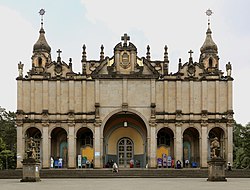 Holy Trinity Cathedral in Addis Ababa, the seat of the Ethiopian Orthodox Tewahedo Church | |
| Abridgement | EOTC |
| Classification | Eastern Christianity |
| Orientation | Oriental Orthodoxy |
| Scripture | Orthodox Tewahedo Bible |
| Theology | Miaphysite |
| Polity | Episcopal |
| Primate | Mathias |
| Region | Ethiopia and Ethiopian diaspora |
| Language | Geʽez, Amharic, Oromo, Tigrinya |
| Liturgy | Alexandrian |
| Headquarters | Holy Trinity Cathedral, Addis Ababa, Ethiopia |
| Founder | Saint Frumentius according to Ethiopian Orthodox tradition |
| Origin | 4th century Kingdom of Aksum |
| Branched from | Orthodox Tewahedo |
| Separations | American synod-in-exile (1992-2018) |
| Members | 36 million[2] [3] [4] [5] |
| Other proper noun(due south) | Ethiopian Orthodox Church building |

The Ethiopian Orthodox Tewahedo Church (Amharic: የኢትዮጵያ ኦርቶዶክስ ተዋሕዶ ቤተ ክርስቲያን,[1] Yäityop'ya ortodoks täwahedo bétäkrestyan) is the largest Oriental Orthodox church. 1 of the few Christian churches in sub-Saharan Africa originating earlier European colonization of the continent,[6] the Ethiopian Orthodox Tewahedo Church dates back centuries, and has a current membership of about 36 million people,[2] [3] [4] [5] the bulk of whom live in Federal democratic republic of ethiopia.[7] It is a founding member of the World Council of Churches.[8] The Ethiopian Orthodox Tewahedo Church is in communion with the other Oriental Orthodox churches (the Eritrean Orthodox Tewahedo Church building, the Coptic Orthodox Church building of Alexandria, the Malankara Orthodox Syrian Church, the Armenian Apostolic Church and the Syriac Orthodox Church).
The Ethiopian Orthodox Tewahedo Church had been administratively part of the Coptic Orthodox Church building of Alexandria from the first half of the 4th century until 1959, when information technology was granted autocephaly with its own patriarch by Saint Pope Cyril VI of Alexandria, Pope of the Coptic Orthodox Church building of Alexandria.[9]
Tewahedo (Geʽez: ተዋሕዶ) is a Geʽez discussion significant "united as one". This word refers to the Oriental Orthodox belief in the ane perfectly unified nature of Christ; i.east., a complete union of the divine and human being natures into one nature is cocky-evident in order to achieve the divine salvation of mankind, as opposed to the "ii natures of Christ" belief commonly held by the Latin and Eastern Catholic, Eastern Orthodox, Anglican, Lutheran and almost other Protestant churches. The Oriental Orthodox Churches adhere to a miaphysitic Christological view followed by Cyril of Alexandria, the leading protagonist in the Christological debates of the 4th and fifth centuries, who advocated mia physis tou theou logou sesarkōmenē, or "one (mia) nature of the Word of God incarnate" (μία φύσις τοῦ θεοῦ λόγου σεσαρκωμένη) and a hypostatic union (ἕνωσις καθ' ὑπόστασιν, henōsis kath hypostasin). The stardom of this stance was that the incarnate Christ has ane nature, but that ane nature is of the two natures, divine and human, and retains all the characteristics of both subsequently the union.
Miaphysitism holds that in the one person of Jesus Christ, divinity and humanity are united in one (μία, mia) nature (φύσις - "physis") without separation, without confusion, without amending and without mixing where Christ is consubstantial with God the Father.[ten] Effectually 500 bishops within the patriarchates of Alexandria, Antioch and Jerusalem refused to have the dyophysitism (two natures) doctrine decreed past the Council of Chalcedon in 451, an incident that resulted in the second major split in the main torso of the state church of the Roman Empire.[11]
Proper name [edit]
Tewahedo (Ge'ez: ተዋሕዶ täwaḥədo) is a Ge'ez word meaning "existence made one" or "unified". This word refers to the Oriental Orthodox belief in the ane blended unified nature of Christ; i.e., a belief that a consummate, natural matrimony of the divine and human natures into one is self-axiomatic in gild to accomplish the divine salvation of humankind. This is in contrast to the "ii natures of Christ" belief (unmixed, merely unseparated divine and human being natures, called the hypostatic union) which is held by the Catholic Church and the Eastern Orthodox Church.
The Oriental Orthodox Churches are known as "non-Chalcedonian", and, sometimes by outsiders as "monophysite" (meaning "One Single Nature", in innuendo to Jesus Christ). However, these churches themselves describe their Christology as miaphysite,[12] [xiii] pregnant "one united nature" in reference to Jesus (the Greek equivalent of "Tewahedo").
History [edit]
Origins [edit]

Many traditions merits that Christian teachings were introduced to the region immediately later on Pentecost. John Chrysostom speaks of the "Ethiopians present in Jerusalem" every bit beingness able to understand the preaching of Saint Peter in Acts, ii:38.[xiv] Possible missions of some of the Apostles in the lands at present chosen Federal democratic republic of ethiopia is also reported as early as the 4th century. Socrates of Constantinople includes Ethiopia in his list as one of the regions preached past Matthew the Apostle,[fifteen] where a specific mention of "Ethiopia south of the Caspian Body of water" can be confirmed in some traditions such as the Roman Catholic Church amidst others.[16] Ethiopian Church tradition tells that Bartholomew accompanied Matthew in a mission which lasted for at least 3 months.[14] Paintings depicting these missions are available in the Church of St. Matthew found in the Province of Pisa, in northern Italy portrayed by Francesco Trevisan (1650–1740) and Marco Benefial (1688–1764).[17]
The earliest account of an Ethiopian converted to the faith in the New Testament books is a majestic official baptized by Philip the Evangelist (distinct from Philip the Apostle), 1 of the seven deacons (Acts, eight:26–27):
Then the angel of the Lord said to Philip, Commencement out and get south to the road that leads down from Jerusalem to Gaza. So he set out and was on his way when he caught sight of an Ethiopian. This man was a eunuch, a loftier official of the Kandake (Candace) Queen of Ethiopia in charge of all her treasure. (Acts, 8:26–27)
The passage continues past describing how Philip helped the Ethiopian treasurer understand a passage from the Volume of Isaiah that the Ethiopian was reading. After Philip interpreted the passage as prophecy referring to Jesus Christ, the Ethiopian requested that Philip cognominate him, and Philip did so. The Ethiopic version of this poetry reads "Hendeke" (ህንደኬ); Queen Gersamot Hendeke VII was the Queen of Ethiopia from c. 42 to 52. Where the possibility of gospel missions by the Ethiopian eunuch cannot be directly inferred from the Books of the New Attestation, Irenaeus of Lyons around 180 AD writes that "Simon Backos" preached the good news in his homeland outlining too the theme of his preaching as being the coming in flesh of God that "was preached to y'all all before."[18] The same kind of witness is shared by 3rd and 4th century writers such as Eusebius of Caesarea[19] and Origen of Alexandria.[xiv]

Early Christianity became the established church of the Ethiopian Axumite Kingdom under king Ezana in the 4th century when priesthood and the sacraments were brought for the showtime time through a Syrian Greek named Frumentius, known by the local population in Ethiopia as "Selama, Kesaté Birhan" ("Father of Peace, Revealer of Light"). As a youth, Frumentius had been shipwrecked with his brother Aedesius on the Eritrean declension. The brothers managed to be brought to the royal court, where they rose to positions of influence and baptized Emperor Ezana. Frumentius is as well believed to have established the first monastery in Ethiopia, named Dabba Selama afterwards him. In 2016, scientists excavated a 4th-century Advertizing basilica (radio-carbon dated) in northeastern Federal democratic republic of ethiopia at a site called Beta Samati. This is the earliest known physical evidence of a church in sub-Saharan Africa.[6]
Centre Ages [edit]
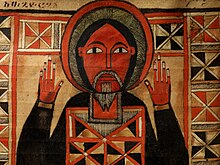
Late 17th century portrait of Giyorgis past Baselyos
Union with the Coptic Orthodox Church of Alexandria continued after the Arab conquest of Egypt. Abu Saleh records in the 12th century that the patriarch always sent letters twice a year to the kings of Abyssinia (Federal democratic republic of ethiopia) and Nubia, until Al Hakim stopped the do. Cyril, 67th patriarch, sent Severus as bishop, with orders to put downward polygamy and to enforce the observance of canonical consecration for all churches. These examples show the close relations of the two churches throughout the Eye Ages.[twenty] In 1439, in the reign of Zara Yaqob, a religious discussion between Giyorgis and a French visitor led to the acceleration of an embassy from Ethiopia to the Vatican.[20]
Jesuit acting [edit]
The catamenia of Jesuit influence, which broke the connexion with Egypt, began a new affiliate in church history. The initiative in Roman Catholic missions to Ethiopia was taken, not by Rome, but by Portugal, in the course of a conflict with the Muslim Ottoman Empire and the Sultanate of Adal for the command of the trade route to India via the Cerise Sea.[21]
In 1507 Mateus, or Matthew, an Armenian, had been sent every bit an Ethiopian envoy to Portugal. In 1520 an embassy under Dom Rodrigo de Lima landed in Federal democratic republic of ethiopia. An interesting account of the Portuguese mission, which lasted for several years, was written by Francisco Álvares, its chaplain.[22]
Later, Ignatius Loyola wished to take upwardly the task of conversion, simply was forbidden to do so. Instead, the pope sent out João Nunes Barreto as patriarch of the East Indies, with Andre de Oviedo as bishop; and from Goa envoys went to Federal democratic republic of ethiopia, followed by Oviedo himself, to secure the king's adherence to Rome. Subsequently repeated failures some measure of success was achieved under Emperor Susenyos I, just not until 1624 did the Emperor make formal submission to the pope.[22] Susenyos made Roman Catholicism the official land organized religion simply was met with heavy resistance past his subjects and by the authorities of the Ethiopian Orthodox Church, and eventually had to abdicate in 1632 in favour of his son, Fasilides, who promptly restored Ethiopian Orthodox Christianity as the state religion. He then in 1633 expelled the Jesuits, and in 1665 Fasilides ordered that all Jesuit books (the Books of the Franks) exist burned.[ citation needed ]
Influence on the Reformation [edit]

Icon of Samuel of Waldebba, a 15th-century Ethiopian monk and austere of the Ethiopian Orthodox Church.
David Daniels has suggested that the Ethiopian Church has had a stronger bear on on the Reformation than most scholars admit. For Martin Luther, who spearheaded the Reformation, Daniels says "the Ethiopian Church building conferred legitimacy on Luther'south emerging Protestant vision of a church outside the authorisation of the Roman Catholic papacy" as it was "an ancient church with direct ties to the apostles".[23] According to Daniels, Martin Luther saw that the Ethiopian Orthodox Church practiced elements of faith including "communion in both kind, colloquial Scriptures, and married clergy" and these practices became customary in the Lutheran churches. The Ethiopian church building as well rejected papal supremacy, purgatory and indulgences, which the Lutherans disagreed with, and thus for Luther, the Ethiopian church was the "truthful forerunner of Protestantism".[23] Luther believed that the Ethiopian church building kept truthful apostolic practices which the Lutherans would adopt through reading the scriptures.[24]
In 1534, a cleric of the Ethiopian Orthodox Church, Michael the Deacon, met with Martin Luther and affirmed the Augsburg Confession as a "good creed".[25] [23] In improver, Martin Luther stated that the Lutheran Mass agreed with that used by the Ethiopian Orthodox Church.[23] As a effect, the Lutheran churches extended fellowship with the Ethiopian Orthodox Church.[23] [26]
Recent history [edit]

Engraving of Abuna Salama III, head of the Ethiopian Orthodox Tewahedo Church (1841-1867)
In more modern times, the Ethiopian Church has experienced a series of developments. The 19th century witnessed the publication of an Amharic translation of the Bible. Largely the work of Abu Rumi over ten years in Cairo, this version, with some changes, held sway until Emperor Haile Selassie ordered a new translation which appeared in 1960/one.[27] Haile Selassie also played a prominent function in further reforms of the church, which included encouraging the distribution of Abu Rumi'southward translation throughout Ethiopia,[28] too as his promotion of improved didactics of clergy, a meaning step in the Emperor's try being the founding of the Theological College of the Holy Trinity Church in December 1944.[29] A third development came afterward Haile Selassie's restoration to Federal democratic republic of ethiopia, when he issued, on 30 November, Decree Number ii of 1942, a new law reforming the church. The master objectives of this decree were to put the finances of the church in order, to create a primal fund for its activities, and to set along requirements for the appointment of clergy—which had been fairly lax until and then.[30]
The Coptic and Ethiopian churches reached an agreement on 13 July 1948, that led to autocephaly for the Ethiopian Church. Five bishops were immediately consecrated by the Coptic Pope of Alexandria and Patriarch of All Africa, empowered to elect a new patriarch for their church, and the successor to Qerellos IV would have the power to consecrate new bishops.[31] This promotion was completed when Coptic Orthodox Pope Joseph II consecrated an Ethiopian-built-in Archbishop, Abuna Basilios, 14 January 1951. Then in 1959, Pope Cyril Vi of Alexandria crowned Basilios as the first Patriarch of Ethiopia.
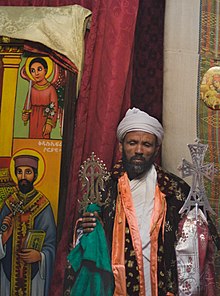
Basilios died in 1971, and was succeeded that year by Tewophilos. With the fall of Emperor Haile Selassie in 1974, the Ethiopian Orthodox Tewahedo Church was disestablished as the country church. The new Marxist government began nationalizing property (including land) endemic by the church. Tewophilos was arrested in 1976 by the Marxist Derg military junta, and secretly executed in 1979. The authorities ordered the church to elect a new Patriarch, and Takla Haymanot was enthroned. The Coptic Orthodox Church refused to recognize the election and enthronement of Tekle Haymanot on the grounds that the Synod of the Ethiopian Church building had not removed Tewophilos and that the government had not publicly acknowledged his death, and he was thus still the legitimate Patriarch of Ethiopia. Formal relations between the two churches were halted, although they remained in communion with each other. Formal relations betwixt the two churches resumed on July thirteen, 2007.[32]
Tekle Haymanot proved to exist much less accommodating to the Derg regime than it had expected, and so when the patriarch died in 1988, a new patriarch with closer ties to the regime was sought. The Archbishop of Gondar, a member of the Derg-era Ethiopian Parliament, was elected and enthroned as Abuna Merkorios. Following the fall of the Derg regime in 1991, and the coming to power of the EPRDF regime, Merkorios abdicated under public and governmental pressure level. The church then elected a new Patriarch, Paulos, who was recognized past the Coptic Orthodox Pope of Alexandria. The former Merkorios and then fled abroad, and appear from exile that his abdication had been made under duress and thus he was all the same the legitimate Patriarch of Federal democratic republic of ethiopia. Several bishops likewise went into exile and formed a break-abroad alternate synod.[33]
Every bit of 2005, there are many Ethiopian Orthodox churches located throughout the United States and other countries to which Ethiopians have migrated (Archbishop Yesehaq 1997). The Church claims about 36 million members in Ethiopia, forming 43.5% the state's population.[3] [5] [4]
Paulos died on 16 Baronial 2012, followed four days later by Prime Minister Meles Zenawi.[34] On 28 February 2013, a college of electors assembled in Addis Ababa and elected Mathias to be the 6th Patriarch of the Ethiopian Orthodox Church.[35]
On 25 July 2018, delegates from the Patriarchate in Addis Ababa, Federal democratic republic of ethiopia and those in the United States, declared reunification in Washington, D.C. with the assist of Ethiopia'due south Prime number Minister Abiy Ahmed. Declaring the terminate of a 26-year-sometime schism, the church building appear that information technology acknowledges 2 Patriarchs, Merkorios, Fourth Patriarch of Ethiopia and Mathias I, Sixth Patriarch and Catholicos of Ethiopia, Archbishop of Axum and Ichege of the See of Saint Taklehaimanot.[36]
Traditions [edit]

Priests and deacons conducting a church service at Saint Michael Ethiopian Orthodox Tewahedo Church, Washington, DC, U.s.a..
The faith and practice of Orthodox Ethiopian Christians include elements from Miaphysite Christianity as it has adult in Ethiopia over the centuries. Christian behavior include belief in God (in Ge'ez / Amharic, ′Egziabeher, lit. "Lord of the Universe"), veneration to the Virgin Mary, the angels, and the saints, too others. According to the Ethiopian Orthodox Church building itself, in that location are no non-Christian elements in the religion other than those from the Old Attestation, or Higge 'Orit (ሕገ ኦሪት),[ commendation needed ] to which are added those from the New Attestation, or Higge Wongiel (ሕገ ወንጌል).[ citation needed ] [37] A hierarchy of Kidusan/ቅዱሳን[ commendation needed ] (angelic messengers and saints) conveys the prayers of the faithful to God and carries out the divine will, so when an Ethiopian Christian is in difficulty, he or she appeals to them too as to God. In more than formal and regular rituals, priests communicate on behalf of the community, and only priests may enter the inner sanctum of the commonly round or octagonal church where the tabot ("ark") dedicated to the church building'south patron saint is housed.[38] [ unreliable source? ] On important religious holidays, the tabot is carried on the head of a priest and escorted in procession outside the church. It is the tabot, not the church, which is consecrated. At many services, nearly parish members remain in the outer ring, where debteras sing hymns and dance.[39]

Processional crosses carried on long poles in Ethiopian Orthodox religious processions
The Eucharist is given but to those who feel pure, take fasted regularly, and have, in general, properly conducted themselves.[38] In exercise, communion is mainly limited to immature children and the elderly; those who are at a sexually active historic period or who have sexual desires generally practice non receive the Eucharist.[38] [40] Worshipers receiving communion may enter the middle band of the church to do so.[38]
Ethiopian Orthodox believers are strict Trinitarians,[41] maintaining the Orthodox educational activity that God is united in three persons: Father, Son, and Holy Spirit. This concept is known as səllasé (ሥላሴ),[ citation needed ] Ge'ez for "Trinity".
Daily services establish only a small-scale role of an Ethiopian Orthodox Christian'southward religious observance. Several holy days crave prolonged services, singing and dancing, and feasting.
Fast days [edit]
An important religious requirement, however, is the keeping of fast days, during which adherents abstain from consuming meat and animal products, and refrain from sexual activity.[38] [twoscore] [42] The Ethiopian Orthodox Church has 250 fasting days, 180 of which are obligatory for laypeople, non simply monks and priests, when vegan food is eaten by the faithful. During the 40-solar day Advent fast, but ane vegan repast is immune per day.[43]

- Fast for Hudadi or Abiye Tsome [ሁዳዴ/ዓብይ ጾም][ citation needed ] (Great Lent), 55 days prior to Easter (Fasika).[44] [45] This fast is divided into three split periods: Tsome Hirkal (ጾመ ህርቃል),[ citation needed ] eight days commemorating an early Christian figure; Tsome Arba (ጾመ አርባ),[ citation needed ] forty days of Lent; and Tsome Himamat (ጾመ ሕማማት),[ citation needed ] vii days commemorating Holy Week.[44] [45]
- Fast of the Apostles, 10–xl days, which the Apostles kept after they had received the Holy Spirit. Information technology begins after Pentecost.
- The fast Tsome Dihnet (ጾመ ድህነት),[ citation needed ] which is on Wednesdays in commemoration of the plot organized to impale Jesus Christ by Caiaphas and the members of the house of the high priest and Fridays in commemoration of the Crucifixion of Jesus Christ (starts on Wed later on Pentecost and spans up to Easter, in other words all Wednesdays and Fridays except during 50 days after Easter).[38]
- The fast of Dormition, sixteen days.
- The fast preceding Christmas, 40 days (Appearance). It begins with Sibket on 15th Hedar and ends on Christmas Eve with the feast of Gena and the 29th of Tahsas and 28th if the twelvemonth is preceded by leap year.
- The Fast of Nineveh, commemorating the preaching of Jonah. It comes on Monday, Tuesday and Wednesday of the tertiary week before Lent.
- The gahad of Timkat (Epiphany), fast on the eve of Epiphany.
In addition to standard holy days, most Christians notice many saints' days. A man might give a small banquet on his personal saint'southward twenty-four hour period. The local voluntary association (called the maheber) continued with each church honours its patron saint with a special service and a banquet two or iii times a year.[39]
Exorcism [edit]
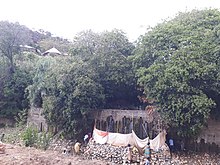
Priests intervene and perform exorcisms on behalf of those believed to be afflicted by demons or buda. According to a 2010 Pew Research Middle written report, 74% of Christians in Ethiopia study having experienced or witnessed an exorcism.[46] Demon-possessed persons are brought to a church or prayer coming together.[47] Frequently, when an ill person has non responded to modern medical treatment, the disease is attributed to demons.[47] Unusual or specially perverse deeds, particularly when performed in public, are symptomatic of a demoniac.[47] Superhuman force — such as breaking one's bindings, as described in the New Testament accounts — along with glossolalia are observed in the afflicted.[47] Amsalu Geleta, in a modern case written report, relates elements that are common to Ethiopian Christian exorcisms:
It includes singing praise and victory songs, reading from the Scripture, prayer and confronting the spirit in the proper name of Jesus. Dialogue with the spirit is some other important part of the exorcism ceremony. It helps the counsellor (exorcist) to know how the spirit was operating in the life of the demoniac. The signs and events mentioned past the spirit are affirmed by the victim afterward deliverance.[47]
The exorcism is not ever successful, and Geleta notes another example in which the usual methods were unsuccessful, and the demons apparently left the subject at a later fourth dimension. In any event, "in all cases the spirit is commanded in no other name than the proper noun of Jesus."[47]
Biblical canon [edit]

Drawing of the Virgin Mary 'with her beloved son' in pencil and ink, from a manuscript copy of Weddasé Māryām, circa 1875.
The Orthodox Tewahedo Church Canon contains 81 books. This canon contains the books accepted past other Orthodox Christians.[48]
- The Narrower Canon also includes Enoch, Jubilees, and I II Three Meqabyan. (These are unrelated to the Greek I, II, III Maccabees with which they are often dislocated.) The canonical Enoch differs from the editions of the Ge'ez manuscripts in the British Museum and elsewhere (A-Q) used by foreign scholars (OTP), for example in the treatment of the Nephilim of Genesis half dozen.[ citation needed ] The current 81-book version, published in 1986, contains the same text as previously published in the Haile Selassie Version of the Bible, only with some modest modifications to the New Attestation translation.
- Some sources speak of the Broader Catechism, which has never been published as a single compilation but is said[ past whom? ] to include all of the Narrower Canon, also as additional New Testament books said to have been used by the early church: two Books of the Covenant, four Books of Sinodos, an Epistle of Peter to Clement — also known as "Ethiopic Cloudless" — and the Ethiopic Didascalia. These may not all bear close resemblance to works with similar titles known in the Due west. An eight-office Ethiopic version of the history of the Jewish people written by Joseph ben Gorion, known as the 'Pseudo-Josephus', is considered[ past whom? ] part of the broader catechism, though it would exist considered an Old Testament work.[49]
Language [edit]

Ethiopian Orthodox celebration of Meskel (Geʽez for "cross")
The divine services of the Ethiopian Church are celebrated in Geʽez. It has been the liturgical language of the church at least since the arrival of the Nine Saints (Pantelewon, Gerima (Isaac, or Yeshaq), Aftse, Guba, Alef, Yem'ata, Liqanos, and Sehma), who fled persecution past the Byzantine Emperor after the Council of Chalcedon (451).[ commendation needed ] The Greek Septuagint was the version of the Quondam Testament originally translated into Ge'ez, but after revisions show clear evidence of the use of Hebrew, Syriac and Standard arabic sources. The first translation into a modern vernacular was done in the 19th century by a human who is unremarkably known as Abu Rumi. Later, Haile Selassie sponsored Amharic translations of the Ge'ez Scriptures during his reign, 1 before Globe State of war Ii and one after. Sermons today are commonly delivered in the local language.[ citation needed ]
Architecture [edit]

There are many monolithic (rock-hewn) churches in Federal democratic republic of ethiopia, virtually famously eleven churches at Lalibela. Besides these, 2 main types of architecture are found—one basilican, the other native. The Church of Our Lady Mary of Zion at Axum is an instance of the basilican design, though the early basilicas are nearly all in ruin. These examples show the influence of the architects who, in the sixth century, built the basilicas at Sanʻāʼ and elsewhere in the Arabian Peninsula. There are two forms of native churches: ane oblong, traditionally found in Tigray; the other circular, traditionally constitute in Amhara and Shewa (though either style may be found elsewhere). In both forms, the sanctuary is square and stands clear in the centre, and the arrangements are based on Jewish tradition. Walls and ceilings are adorned with frescoes. A courtyard, circular or rectangular, surrounds the body of the church. Modern Ethiopian churches may incorporate the basilican or native styles and use contemporary construction techniques and materials. In rural areas, the church and outer court are oftentimes thatched, with mud-congenital walls. The church buildings are typically surrounded past a forested surface area, acting as a reservoir of biodiversity in otherwise de-forested parts of the country.[fifty] [51] [22]
Ark of the Covenant [edit]

The Ethiopian Church building claims that ane of its churches, Our Lady Mary of Zion, is host to the original Ark of the Covenant that Moses carried with the Israelites during the Exodus. Simply one priest is allowed into the building where the Ark is located, ostensibly due to biblical warnings of danger. As a outcome, international scholars doubt that the original Ark is truly there, although a case has been put forward past several writers including Graham Hancock in his book The Sign and the Seal.[ citation needed ]
Throughout Ethiopia, Orthodox churches are not considered churches until the local bishop gives them a tabot, a replica of the tablets in the original Ark of the Covenant. The tabot is at least six inches (15 cm) square, and it is made of either alabaster, marble, or wood (encounter acacia). It is always kept in ornate coverings on the altar. Just priests are allowed to touch on the tabot. In an elaborate procession, the tabot is carried around the outside of the church amid blithesome vocal on the feast day of that detail church's namesake. On the nifty Banquet of T'imk'et, known every bit Epiphany or Theophany in Europe, a group of churches send their tabot to gloat the occasion at a common location where a pool of water or a river is to exist institute.[ commendation needed ]
Similarities to Judaism and Islam [edit]

The Ethiopian Church places a heavier emphasis on One-time Attestation teachings than one might find in Eastern Orthodox, Roman Catholic or Protestant churches, and its followers adhere to certain practices that 1 finds in Orthodox or Conservative Judaism. Ethiopian Christians, like some other Eastern Christians, traditionally follow dietary rules that are like to Jewish Kashrut, specifically with regard to the slaughter of animals. Similarly, pork is prohibited, though unlike Rabbinical Kashrut, Ethiopian cuisine does mix dairy products with meat, which in plow makes it even closer to Karaite and Islamic dietary laws (run into Halal). Women are prohibited from entering the church building temple during flow; they are likewise expected to cover their pilus with a big scarf (or shash) while in church, as described in i Corinthians, chapter 11. Equally with Orthodox synagogues, men and women sit separately in the Ethiopian church, with men on the left and women on the right (when facing the altar).[52] (Women covering their heads and separation of the sexes in churches officially is common to some other Christian traditions; it is as well the rule in some non-Christian religions, Islam and Orthodox Judaism among them). Ethiopian Orthodox worshipers remove their shoes when entering a church temple,[52] in accordance with Exodus iii:5 (in which Moses, while viewing the burning bush, was allowable to remove his shoes while standing on holy ground). Furthermore, the Ethiopian Orthodox Tewahedo Church upholds Sabbatarianism, observing the seventh-day Sabbath (Saturday), in addition to the Lord's Day (Sunday),[53] although more than accent, considering of the Resurrection of Christ, is laid upon Sunday. The Ethiopian Orthodox Church calls for male circumcision, with near-universal prevalence among Orthodox men in Ethiopia.[54] [55]
Debtera [edit]

A debtera is an itinerant lay priest effigy trained by the Ethiopian Church equally a scribe, cantor, and often as a folk healer, who may also part in roles comparable to a deacon or exorcist. Folklore and legends ascribe the office of magician to the debtera also.[ citation needed ]
Patriarch-Catholicoi, archbishops and bishops [edit]
- Patriarch-Catholicos
Since 1959, when the church building was granted autocephaly by Cyril VI, Pope of the Coptic Orthodox Church building of Alexandria, an Ethiopian Patriarch-Catholicos of Eritrea as well carrying the title of Abuna is the caput of the Ethiopian Orthodox Tewahedo Church building. The Abuna who is known officially as Patriarch and Catholicos of Ethiopia, Archbishop of Axum and Ichege of the See of Saint Taklahaimanot. the incumbent caput of the Ethiopian Orthodox Tewahedo Church is Mathias who acceded to this position on 28 February 2013.
- Archbishops and bishops
Federal democratic republic of ethiopia:
- Mathias and Merkorios, Co-Patriarchs and Head of all Archbishops of the Ethiopian Orthodox Tewahedo Church building
Canada:
- Demetrios, archbishop of Eastern Canada
- Mathias, archbishop of Western Canada
Eye East:
- Dimetros, Archbishop of the United Arab Emirates and its surrounding areas
- Kewestos, Archbishop of Jerusalem[56]
S America:
- Thaddaeus, archbishop of the Caribbean and Latin America
U.s.:
- Fanuel, archbishop of Washington, D.C
- Markos, archbishop of New York and its surrounding areas.
- Philipos, archbishop of Pennsylvania and Head of Eyesus Church in Baltimore
- Yaekob, archbishop of Georgia and its surrounding areas (Southeastern States)
- Ewesatewos, archbishop of Minnesota and its surrounding areas.
- Natnael, archbishop of Colorado and surrounding areas
- Selama, archbishop of Ohio
- Sawiros, archbishop of Texas
- Michael, archbishop of Northern California
- Barnabas, archbishop of Southern California
Western Europe:
- Yosef, Archbishop of Europe, in Rome.
Eparchies [edit]
The current eparchies of the church include:[57]
- Awassa (Sidama)
- Axum
- Ambo
- Arsi
- Assosa
- Distant
- Bale Gobe
- Wollega
- Northward Wollo
- S Wollo (Dessie)
- Gambela
- West Gojam (Bahr Dar)
- E Gojam (Debre Markos)
- North Gondar
- South Gondar (Debre Tabor)
- Jerusalem
- Illubabor
- Jijiga
- Jimma
- Kenbata
- Methara
- Mizan Teferi (Kaffa)
- Negele-Borena
- Ogaden (Somali Region)
- Omo
- Selalya
- E Tigray
- West Tigray
- Central Tigray (Me'kele)
- South Tigray
- Khartoum and Nubia
- Shewa (Adama)
- North Shoa (Debre Berhan)
- Washington D.C and surrounding areas
- Eastern Canada
- Western Canada
- Trinidad and Latin America
Meet besides [edit]
- Abuna
- Christianity in Ethiopia
- Eritrean Orthodox Tewahedo Church
- Ethiopian Catholic Church
- Ethiopian chant
- Ethiopian Orthodox Church in Exile
- List of abunas of Ethiopia
- Oriental Orthodox Church building
Further reading [edit]
- Budge, Ernest Alfred Wallis (1928). . Cambridge, The Academy Press.
References [edit]
- ^ a b Ethiopian Orthodox Tewahedo Church building, Addis Ababa. "የኢትዮጵያ ኦርቶዶክስ ተዋሕዶ ቤተ ክርስቲያን". ZEOrthodox.org. Ethiopian Orthodox Tewahedo Church. Retrieved 2021-06-20 .
- ^ a b "Orthodox Christianity in the 21st Century". Pew Inquiry Center'south Religion & Public Life Project. eight November 2017.
Ethiopian Orthodox Tewahedo Church has an estimated 36 meg adherents, about 14% of the world's total Orthodox population.
- ^ a b c Federal Democratic Republic of Ethiopia, Population Demography Commission (4 June 2012). "Summary and Statistical Report of the 2007 Population and Housing Demography Results" (PDF). Archived from the original (PDF) on iv June 2012.
Orthodox 32,138,126
- ^ a b c "Ethiopian Orthodox Tewahedo Church | church building, Federal democratic republic of ethiopia". Encyclopedia Britannica.
In the early 21st century the church claimed more 30 meg adherents in Ethiopia.
- ^ a b c "Ethiopia: An outlier in the Orthodox Christian world". Pew Research Eye.
- ^ a b Harrower, Michael J (Winter 2019). "Beta Samati: discovery and earthworks of an Aksumite town" (PDF). Antiquity. 93 (372): 1534–1552. doi:10.15184/aqy.2019.84 – via Cambridge.org.
- ^ Berhanu Abegaz (2005). "Ethiopia: A Model Nation of Minorities" (accessed vi April 2006)
- ^ "Ethiopian Orthodox Tewahedo Church", World Quango of Churches website (accessed 2 June 2009)
- ^ The Editors of Encyclopaedia Britannica. "Ethiopian Orthodox Tewahedo Church building". Encyclopædia Britannica. Encyclopædia Britannica. Retrieved 2020-07-xxx .
- ^ The Blackwell Companion to Eastern Christianity by Ken Parry 2009 ISBN i-4443-3361-v page 88 [1]
- ^ "Cosmic Encyclopedia: Henoticon". Newadvent.org. 1910-06-01. Retrieved 2013-06-thirty .
- ^ Winkler 1997, p. 33-forty.
- ^ Brock 2016, p. 45–52.
- ^ a b c Meskel and the Ethiopians. EOTC Publication Committee, September 2015
- ^ Socrates and Sozomenus Ecclesiastical Histories, p. 57
- ^ "St. Matthew: Catholic Encyclopedia". Retrieved 2015-12-04 .
- ^ Meskel and the Ethiopians. EOTC Publication Committee September 2015
- ^ Irenaeus of Lyons, "Adversus haereses" III. 12. eight
- ^ Eusebius Pamphilius, Church History
- ^ a b Butler 1911, p. 95.
- ^ Butler 1911, pp. 95–96.
- ^ a b c Butler 1911, p. 96.
- ^ a b c d due east Daniels, David D. (21 October 2017). "Honor the Reformation's African roots". The Commercial Appeal. Retrieved 9 April 2018.
- ^ "Martin Luther and Ethiopian Christianity: Historical Traces | The University of Chicago Divinity School". divinity.uchicago.edu . Retrieved 2022-01-28 .
- ^ Daniels, David D. (2 November 2017). "Martin Luther and Ethiopian Christianity: Historical Traces". University of Chicago. Retrieved 9 April 2018.
Luther expressed his approval of the Church of Ethiopia along with his embrace of Deacon Michael in a letter dated July 4, 1534: "For this reason nosotros ask that practiced people would demonstrate Christian love too to this [Ethiopian] visitor." According to Luther, Michael responded positively to his articles of the Christian organized religion, proclaiming: "This is a good creed, that is, religion" (see Martin Luther, Tabular array-Talk, November 17, 1538 [WA, TR 4:152-153, no. 4126]).
- ^ Daniels, David D. (31 October 2017). "Martin Luther'due south fascination with Ethiopian Christianity". The Christian Century. Retrieved 9 Apr 2018.
Luther extended total fellowship to Deacon Michael and the Ethiopian Church, an invitation Luther withheld from the Bohemian Brethren (the Hussites) and Reformed Churches continued to Ulrich Zwingli.
- ^ Edward Ullendorff, Ethiopia and the Bible (Oxford: British University, 1988), p. 66
- ^ Margary Perham, The Government of Ethiopia, second edition (London: Faber and Faber, 1969), pp. 121f
- ^ Perham, Regime of Federal democratic republic of ethiopia, p. 132
- ^ Perham, Regime of Ethiopia, pp. 130
- ^ Discussed in fuller detail past Perham, Authorities of Ethiopia, pp. 126–130
- ^ ""Common Declaration" of Pope Shenoudah III, Catholicos Aram I, and Patriarch Paulos – News and Media of the Armenian Orthodox Church, 22 July 2007". Archived from the original on 2008-08-28.
- ^ Goldman, Ari L. (22 September 1992). "U.South. Branch Leaves Ethiopian Orthodox Church building". The New York Times . Retrieved 29 April 2016.
- ^ "Ethiopian church building patriarch Abune Paulos dies". BBC News. 16 Baronial 2012. Retrieved 16 August 2012.
- ^ "Ethiopian church appoints Abune Mathias as patriarch". BBC News. 2013-03-01. Retrieved 2013-03-03 .
- ^ "Ethiopian Church building officially alleged reunification in the presence of PM Abiy Ahmed". Borkena Ethiopian News. 2018-07-26. Archived from the original on 2021-09-xi.
- ^ EOTC Doctrine Archived 2011-07-27 at the Wayback Machine
- ^ a b c d due east f Professor Sergew Hable Sellassie & Belaynesh Mikael (2003) [1970]. "Worship in the Ethiopian Orthodox Church". The Church of Ethiopia – A Panorama of History and Spiritual Life. Addis Ababa. Retrieved v Nov 2014 – via EthiopianOrthodox.org.
- ^ a b Turner, John W. "Ethiopian Orthodox Christianity: Religion and practices". A Country Study: Ethiopia (Thomas P. Ofcansky and LaVerle Drupe, eds.) Library of Congress Federal Research Division (1991). This article incorporates text from this source, which is in the public domain.[2].
- ^ a b Molvaer, Reidulf K. (1995). Socialization and Social Command in Federal democratic republic of ethiopia. Äthiopistische Forschungen. Vol. 44. Wiesbaden: Harassowitz. pp. 256–257. ISBN9783447036627.
- ^ "Doctrine of the Ethiopian Orthodox Church" (PDF).
- ^ James Jeffrey (22 March 2017). "Ethiopia: fasting for 55 days". Deutsche Welle. Retrieved 24 March 2017.
- ^ "A 40-Day Vegan Fast, And then, At Last, A January Christmas Feast". NPR.org . Retrieved 2021-06-15 .
- ^ a b "Tsome Nenewe (The Fast of Nineveh)". Minneapolis: Debre Selam Medhanealem Ethiopian Orthodox Tewahedo Church. 28 Jan 2015. Archived from the original on 2015-04-05. Retrieved 30 March 2017.
- ^ a b Robel Arega. "Fasting in the Ethiopian Orthodox Church building". Ethiopian Orthodox Tewahedo Church building Sunday School Department – Mahibere Kidusan. Why Fifty-Five Days?. Retrieved 30 March 2017.
- ^ "Ten things we take learnt about Africa". BBC News. Apr 15, 2010. Retrieved Apr 15, 2010.
In Ethiopia, 74% of Christians say they have experienced or witnessed the devil or evil spirits being driven out of a person
- ^ a b c d e f Geleta, Amsalu Tadesse. "Case Study: Demonization and the Practice of Exorcism in Ethiopian Churches Archived 2010-01-01 at the Wayback Automobile". Lausanne Committee for World Evangelization, Nairobi, Baronial 2000.
- ^ "The Bible". Ethiopian Orthodox Tewahedo Church. Retrieved 23 January 2012.
- ^ Cowley, R.W. (1974). "The Biblical Canon Of The Ethiopian Orthodox Church Today". Ostkirchliche Studien. 23: 318–323. Retrieved 21 January 2012.
- ^ Abbott, Alison. "Biodiversity thrives in Ethiopia'south church building forests". Nature . Retrieved 31 January 2019.
- ^ Bahnson, Fred (January 11, 2020). "The Church Forests of Ethiopia: A Mystical Geography". Emergence Magazine.
- ^ a b Hable Selassie, Sergew (1997). The Church of Ethiopia – A panorama of History and Spiritual Life. Addis Abeba, Ethiopia: Berhanena Selam. p. 66.
- ^ Binns, John (28 November 2016). The Orthodox Church building of Ethiopia: A History. I.B.Tauris. p. 58. ISBN9781786720375.
The rex presided, overruled the bishops who were committed to the more than usual position that Sunday only was a holy day, and decreed that the Sabbatarian teaching of the northern monks became the position of the church.
- ^ "Circumcision". Columbia Encyclopedia. Columbia Academy Press. 2011.
- ^ N. Stearns, Peter (2008). The Oxford Encyclopedia of the Modern World. Oxford University Press. p. 179. ISBN9780195176322.
Uniformly practiced by Jews, Muslims, and the members of Coptic, Ethiopian, and Eritrean Orthodox Churches, male circumcision remains prevalent in many regions of the globe, particularly Africa, Due south and East asia, Oceania, and Anglosphere countries.
- ^ "Jerusalem – Heads of Churches". Earth Council of Churches. Archived from the original on 2011-08-28.
- ^ Eparchies of the Ethiopian Church (Russian)
- This article incorporates text from a publication now in the public domain:Butler, Alfred Joshua (1911). "Abyssinian Church". In Chisholm, Hugh (ed.). Encyclopædia Britannica. Vol. 1 (11th ed.). Cambridge Academy Press. pp. 95–96.

Bibliography [edit]
- Brock, Sebastian P. (2016). "Miaphysite, not Monophysite!". Cristianesimo Nella Storia. 37 (1): 45–52. ISBN9788815261687.
- Grillmeier, Aloys; Hainthaler, Theresia (1996). Christ in Christian Tradition: The Church building of Alexandria with Nubia and Federal democratic republic of ethiopia after 451. Vol. ii/iv. Louisville: Westminster John Knox Press. ISBN9780664223007.
- Archbishop Yesehaq. 1997. The Ethiopian Tewahedo Church: An Integrally African Church. Winston-Derek Publishers.
- Meyendorff, John (1989). Imperial unity and Christian divisions: The Church 450-680 A.D. Crestwood, NY: St. Vladimir'south Seminary Printing. ISBN9780881410563.
- Mikre-Sellassie Gebre-Amanuel. 1993. "The Bible and its catechism in the Ethiopian Orthodox Church." The Bible Translator 44/ane:111-123.
- Winkler, Dietmar Due west. (1997). "Miaphysitism: A New Term for Employ in the History of Dogma and in Ecumenical Theology". The Harp. ten (3): 33–40.
External links [edit]
- Divine Liturgy of the Ethiopian Orthodox Church
- Ethiopian Religions – Christianity, Islam, Judaism & Paganism
- Ethiopian Orthodox Tewahedo Church (Ethiopian Orthodox Tewahedo Church building -the oldest site)
- CNEWA article by Ronald Roberson: Ethiopian Orthodox Tewahedo Church building
- Historical Development of Ethiopian Anaphoras
- Abbink, J. A Bibliography on Christianity in Ethiopia. Leiden: African Studies Centre, 2003 (PDF)
Source: https://en.wikipedia.org/wiki/Ethiopian_Orthodox_Tewahedo_Church
0 Response to "The Origin of the Trinity in Art and Religionethiopian Roots in the Egyptgreek and Hebrew"
Post a Comment