Review for Article 15 to 23 in Christian Morality
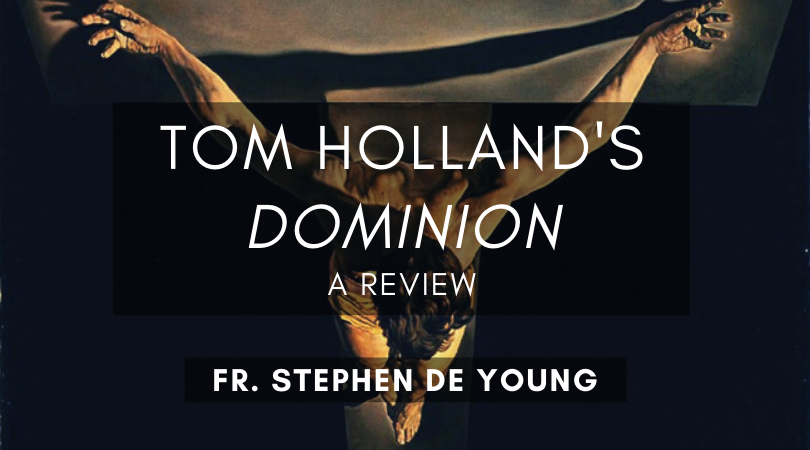
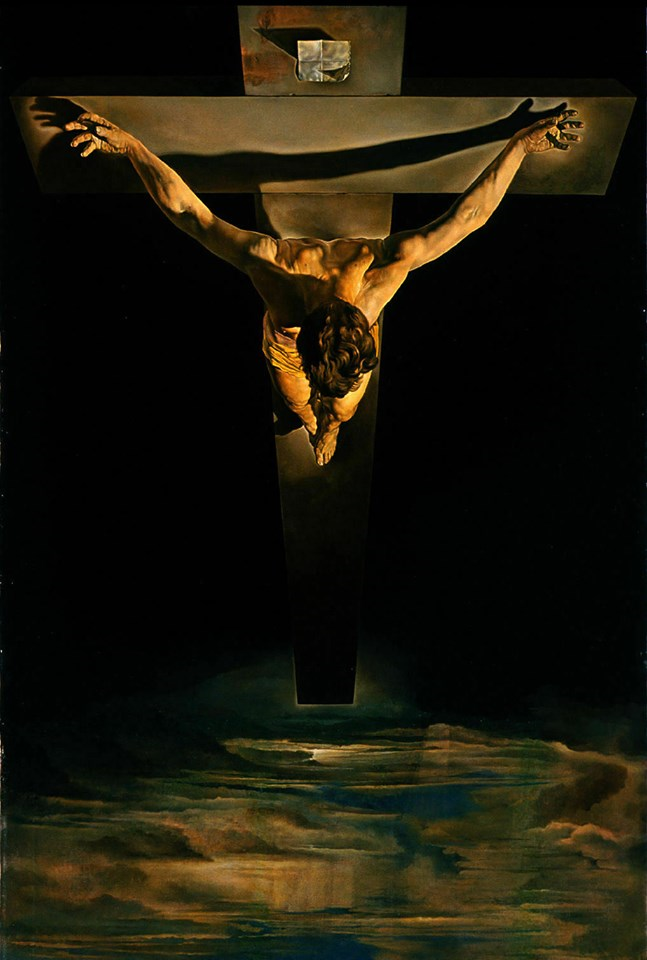
The major themes of Tom Kingdom of the netherlands's newest book of history, Dominion, are exemplified past the differing presentation of the volume in the United states equally opposed to Kingdom of the netherlands's native Britain. The British edition of the book is Dominion: The Making of the Western Heed. The cover features the caput of a Corinthian pillar with an inverted modern skyscraper higher up. The American release, on the other hand, is entitled: Dominion: How the Christian Revolution Remade the World. Its cover is graced by Salvador Dali'south "Christ of St. John of the Cantankerous", a depiction of Christ crucified over a misty and chaotic earth, if not before its very foundations.
 The contents of the book in both cases and Holland'south argument are the aforementioned. The difference in presentation, and so, expresses a deviation in the audience of readers and how fraternal they might be expected to be toward his message. Dominion is a work of cultural history, non church history, merely it communicates that the history of the culture of the European Due west and its old colonies cannot be disentangled from Christianity and its key teachings.
Dominion grew out of an essay past The netherlands published by the New Statesman in 2016 which itself expressed the ancestry of The netherlands's reappraisal of Christianity. Most of Holland's published piece of work surrounds antiquity and, in item, its empires. In the essay and the subsequent volume, Kingdom of the netherlands describes his childhood love of dinosaurs which ultimately led to his abandonment of the faith of his youth. His after love of the classical globe he sees as closely related.
The likes of Caesar, Augustus, and Xerxes are super predators on par with any Tyrannosaurus King. These are men who boasted publicly of having killed and enslaved thousands. These are men who viewed themselves as and then superior to the common run of humanity that their only existent kin were the gods. These are men who found the poor, the weak, the sick, the humble to be pathetic filth more akin to animals than to themselves. While The netherlands was non then and is not now a Christian in religious belief, he has discovered that his own moral sense has fiddling to exercise with that of the classical world and everything to do with the moral teachings of Christianity.
This new book explores that initial insight. Holland begins in familiar territory, the Farsi wars, and describes the classical world in all of its unmerciful glory before moving on to the globe of Judaism and thence inbound into the era of Christianity. In regard to Judaism in detail in the 2nd Temple catamenia, Kingdom of the netherlands adopts for the purposes of his argument the usually held views of critical historians. These include the Persian origin of many elements of Judaism, aboriginal State of israel'due south early polytheism from which monotheism afterwards evolved, and that at to the lowest degree the early history of the Old Testament is entirely myth in the sense of fiction.
Every bit a non-believer, these are undoubtedly Holland'due south actual positions, only even were they not, there would exist trivial sense in contesting them hither. The arguments involved would constitute other books entirely. More directly, nevertheless, The netherlands's argument is directed toward a general audience and not to Christians only. He aims to correct the tape of Western history on several counts and to demonstrate that even those who consider themselves most secular in our contemporary cultural moment are, in fact, Christian in their bones. Our atheists are Christian atheists.
Holland'southward force as a writer has ever been centered in his abilities as a storyteller. His approach in Rule proceeds from this forcefulness. In a sequence of eras beginning in the fifth century BC, Holland selects figures and tells their stories in parallel. In the fifth century Advertisement, this is Ss. Basil, Gregory of Nyssa, and Macrina, Martin of Tours, Paulinus of Nola, and Augustine. In the thirteenth century, it is Elizabeth of Hungary, Conrad of Marburg, and Thomas Aquinas. In the early function of the twentieth century, information technology is 3 men who fought at the Battle of the Somme in 1916—Otto Dix, Adolf Hitler, and J.R.R. Tolkien.
Holland traces his themes from classical Greece to the nowadays cultural moment. He finds these themes not only within a given era in the stories of people from varied lands and languages just also stretching beyond eras and giving shape to the formation and reformation of Western culture. In an interview, The netherlands described the writings of St. Paul as like a depth charge, the shockwaves of which pulse and ripple outward through the centuries.
Dominion is not, as already indicated, a work of church history. Information technology is not a book aimed at tracking the development of theology or of detail church institutions in the West. Rather, it traces the coaction of Christian teaching and civilisation which has resulted, over two millennia, in a profound transformation of culture. This transformation is apparent both to the extreme counter-cultural nature of Christianity'due south proclamation in the Roman world, the datum which originally inspired Holland'south reflection, but no less so in the works of Nietzsche as simply ane modern example.
Nietzsche had a profound understanding of the nature of Christian teaching and the manner in which it had completely upended the preceding worldview of the classical world. He understood it and he hated it. He further foresaw the consequences that would come up when Western culture finally decided to divest itself of Christian moral teaching and the worldview whose underpinnings it had already rejected at an intellectual level. These consequences were reaped in blood throughout the twentieth century and, should de-Christianization bear witness successful in the time to come, they can only continue and intensify.
The truth, however, every bit Holland shows, is that the de-Christianizers have not been that successful at all. Atheists attack the Scriptures and Christian history as immoral when compared to the standards of Christian morality. They do non do this to undermine the consistency of the Christian worldview from the outside merely rather because they still share that morality which found its origins in Christian didactics.
Aforementioned-sex union advocates reject Christian moral teachings regarding the propriety of sexual relationships but firmly embrace a vision of loving monogamous marriage which is itself purely the product of that same instruction. Pro-choice activists debate for the correct of women to control their own bodies, which dignity constitute its origin in Christian education that women, as well as men, are formed in the image of God and of equal value.
The very idea that women accept a right of consent in sexual matters grew from the beginnings of Christian monasticism. Christian leaders had to transform a culture in which women belonged to their fathers until given by that father to a hubby to allow that a woman could cull not to exist married, to remain chaste if she so desired in society to devote herself and her life to Christ. The culture wars are, in Holland'due south statement, an inter-Christian disharmonize between those who wish to maintain Christian tradition as a historic whole and those who wish to sacrifice or transform some elements while retaining others intact.
The greatest contribution of The netherlands'southward book likely stems from his intimate familiarity with the ancient world. This allows him to present Christianity in a class much closer to the state in which information technology originally existed, rather than equally "a religion". In fact, he traces the development of the thought of the secular from St. Augustine'south struggle to understand the events of his own historic period within the context of his Christianity. He further describes the emergence of the concept of "religion" and its radical transformation over time to its present understanding.
With these afterward developments peeled back, Christianity emerges every bit a system of interacting with agreement the world, described in teachings and lived past the actual human persons of every era. This style of thinking and seeing has been bred into the basic of every person built-in in the West for centuries, though today it may get unnoticed like the air which nosotros breathe. Kingdom of the netherlands'southward mapping of the route from the ancient earth to the present moment illuminates the latter and explains it. It too provides a map, for those so inclined, to walk back through the intervening eras and get in at Christianity'southward cadre at the moment of its ancient birth.
Source: https://blogs.ancientfaith.com/orthodoxyandheterodoxy/2019/11/26/tom-hollands-dominion-a-review/
0 Response to "Review for Article 15 to 23 in Christian Morality"
Post a Comment