Silhouette Family Is What Happens When Two Fall in Love

A traditional silhouette portrait of the late 18th century
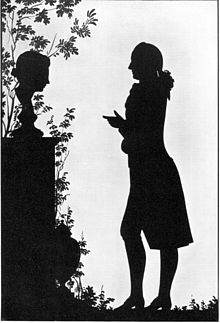
Goethe facing a grave monument, cut paper, 1780
A silhouette ( SIL-oo-ET ,[1] French: [silwɛt]) is the prototype of a person, brute, object or scene represented as a solid shape of a unmarried colour, commonly black, with its edges matching the outline of the subject area. The interior of a silhouette is featureless, and the silhouette is normally presented on a light background, usually white, or none at all. The silhouette differs from an outline, which depicts the edge of an object in a linear form, while a silhouette appears as a solid shape. Silhouette images may be created in any visual creative media,[2] merely were kickoff used to depict pieces of cutting newspaper, which were so stuck to a backing in a contrasting color, and ofttimes framed.
Cutting portraits, mostly in contour, from black carte du jour became popular in the mid-18th century, though the term silhouette was seldom used until the early decades of the 19th century, and the tradition has connected under this name into the 21st century. They represented a cheap but constructive culling to the portrait miniature, and skilled specialist artists could cut a loftier-quality bust portrait, by far the most mutual style, in a affair of minutes, working purely by heart. Other artists, especially from about 1790, drew an outline on newspaper, so painted it in, which could be every bit quick.
From its original graphic meaning, the term silhouette has been extended to describe the sight or representation of a person, object or scene that is backlit, and appears night against a lighter background. Anything that appears this way, for example, a figure continuing backlit in a doorway, may exist described as "in silhouette". Because a silhouette emphasises the outline, the word has likewise been used in the fields of fashion and fitness to describe the shape of a person's body or the shape created by wearing clothing of a particular style or period.
Etymology and origins [edit]
The word silhouette is derived from the name of Étienne de Silhouette, a French finance minister who, in 1759, was forced by France'due south credit crunch during the Seven Years' War to impose severe economic demands upon the French people, particularly the wealthy.[3] Because of de Silhouette'due south austere economies, his name became synonymous with anything done or fabricated cheaply then with these outline portraits.[four] [5] Prior to the appearance of photography, silhouette profiles cutting from black carte du jour were the cheapest fashion of recording a person's appearance.[six] [7]
The term silhouette, although existing from the 18th century, was non applied to the art of portrait-making until the 19th century. In the 18th and early 19th century, "profiles" or "shades" equally they were called were fabricated by 1 of three methods:
- painted on ivory, plaster, paper, card, or in opposite on glass;
- "hollow-cut" where the negative image was traced and and so cutting away from lite colored paper which was and so laid atop a dark background; and
- "cut and paste" where the figure was cut out of nighttime newspaper (usually free-hand) and and then pasted onto a light background.[2]
History [edit]
Mythological origins [edit]

Attic Greek Black-figure Neck Amphora attributed to the Princeton Painter, ca. 550–540 BCE
The silhouette is closely tied in mythology to the origins of art. Pliny the Elder, in his Natural History (circa 77–79 AD) Books XXXIV and XXXV, recounts the origin of painting. In Chapter 5 of Book XXXV, he writes,
"We have no certain knowledge as to the offset of the art of painting, nor does this enquiry fall under our consideration. The Egyptians affirm that information technology was invented among themselves, half dozen one thousand years before it passed into Greece; a vain boast, it is very axiomatic. As to the Greeks, some say that it was invented at Sicyon, others at Corinth; but they all agree that it originated in tracing lines round the human being shadow [...omnes umbra hominis lineis circumducta].". In Chapter xv, he tells the story of Butades of Corinth:
-
- "Butades, a potter of Sicyon, was the first who invented, at Corinth, the art of modelling portraits in the world which he used in his merchandise. It was through his daughter that he made the discovery; who, beingness securely in honey with a immature human about to depart on a long journey, traced the contour of his face, as thrown upon the wall by the light of the lamp [umbram ex facie eius ad lucernam in pariete lineis circumscripsit]. Upon seeing this, her begetter filled in the outline, by compressing clay upon the surface, and and then made a confront in relief, which he then hardened past burn down forth with other articles of pottery."
- In accord with the myth, Greek Black-effigy pottery painting,[8] also known as the black-figure manner or blackness-figure ceramic (Greek, μελανόμορφα, melanomorpha, mutual betwixt the seventh and 5th centuries BC) employs the silhouette and feature profile views of figures and objects on pottery forms. The pots themselves exhibit strong forms in outline that are indicators of their purpose, as well as beingness decorative.[9]
Contour portraits [edit]

The traditional method of making a silhouette portrait

For the delineation of portraits, the profile image has marked advantage over a total-face image in many circumstances, because information technology depends strongly upon the proportions and human relationship of the bony structures of the face up (the forehead, nose and chin) making the image is clear and simple. For this reason profile portraits have been employed on coinage since the Roman era. The early on Renaissance flow saw a way for painted contour portraits and people such as Federico da Montefeltro and Ludovico Sforza were depicted in profile portraits. The contour portrait is strongly linked to the silhouette.
Recent inquiry at Stanford Academy indicates that where previous studies of face recognition have been based on frontal views, studies with silhouettes testify humans are able to extract accurate information most gender and age from the silhouette alone.[x] This is an important concept for artists who design characters for visual media, because the silhouette is the most immediately recognisable and identifiable shape of the graphic symbol.[xi]
Rising of popularity and evolution in the nineteenth century [edit]

A silhouette portrait can exist painted or drawn. However, the traditional method of creating silhouette portraits is to cut them from lightweight black paper-thin, and mount them on a pale (usually white) background. This was the work of specialist artists, often working out of booths at fairs or markets, whose trade competed with that of the more expensive miniaturists patronised by the wealthy. A traditional silhouette portrait creative person would cutting the likeness of a person, freehand, within a few minutes.[12] Some mod silhouette artists also make silhouette portraits from photographs of people taken in contour.[6] These contour images are often head and shoulder length (bosom), but can besides be full length.[xiii]
The work of the physiognomist Johann Caspar Lavater, who used silhouettes to analyse facial types, is thought to have promoted the art.[14] The 18th century silhouette creative person Baronial Edouart cut thousands of portraits in indistinguishable. His subjects included French and British dignity and US presidents. Much of his personal collection was lost in a shipwreck.[fifteen] In England, the best known silhouette creative person, a painter not a cutter, was John Miers, who travelled and worked in different cities, just had a studio on the Strand in London.[16] He advertised "three minute sittings",[17] and the cost might be as low equally half a crown around 1800. Miers' superior products could exist in grisaille, with delicate highlights added in golden or yellowish, and some examples might be painted on various backings, including gesso, glass or ivory.[18] The size was normally pocket-size, with many designed to fit into a locket, but otherwise a bust some three to 5 inches loftier was typical, with half- or full-length portraits proportionately larger.
In America, silhouettes were highly popular from nearly 1790 to 1840.
The physionotrace apparatus invented by Frenchman Gilles-Louis Chrétien in 1783-84 facilitated the production of silhouette portraits past deploying the mechanics of the pantograph to transmit the tracing (via an eyepiece) of the discipline'due south profile silhouette to a needle moving on an engraving plate, from which multiple portrait copies could be printed.[xix] [20] The invention of photography signaled the end of the silhouette as a widespread form of portraiture.[half-dozen]
Maintaining the tradition [edit]
The skill was not lost, and travelling silhouette artists continued to piece of work at state fairs into the 20th century. E. J. Perry and Dai Vernon were artists active in Coney Isle at this time likewise. The popularity of the silhouette portrait is being reborn in a new generation of people who capeesh the silhouette equally a nostalgic way of capturing a pregnant occasion. In the United states and the Uk silhouette artists take websites advert their services at weddings and other such functions.[vi] [21] [22] In England there is an active group of silhouette artists.[23] [12] [24] In Australia, S. John Ross plied his scissors at agricultural shows for 60 years until his death in 2008.[25] Other artists such as Douglas Carpenter produce silhouette images using pen and ink.[26]
The silhouette in fine art, media and illustrations [edit]
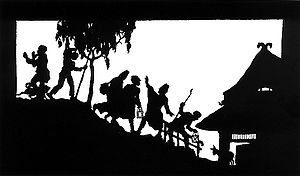
A traditional paper-cut illustration by Wilhelm Gross

Since the late 18th century, silhouette artists have also made small scenes cut from card and mounted on a contrasting background like the portraits. These pictures, known every bit "paper cuts", were ofttimes, but not necessarily, silhouette images.[27] Among 19th century artists to work in this manner was the author Hans Christian Andersen.[28] The modern artist Robert Ryan creates intricate images past this technique, sometimes using them to produce silk-screen prints.[29]
In the late 19th and early 20th century several illustrators employed designs of like advent for making book illustrations. Silhouette pictures could hands exist printed by blocks that were cheaper to produce and longer lasting than detailed black and white illustrations.
Silhouette pictures sometimes appear in books of the early 20th century in conjunction with colour plates. (The colour plates were expensive to produce and each one was glued into the book by paw.) Illustrators who produced silhouette pictures at this time include Arthur Rackham and William Heath Robinson. In breaking with literal realism, artists of the Vorticist, Futurist and Cubist[30] [31] movements employed the silhouette. Illustrators of the tardily 20th century to work in silhouette include January Pienkowski and Jan Ormerod. In the early on 1970s, French artist Philippe Derome uses the black cut silhouette in his portraits of black people. In the 21st century, American artist Kara Walker develops this apply of silhouette to present racial issues in against images.[32]
Shadow theatre [edit]
Originating in the orient with traditions such as the shadow theatres of Indonesia, the shadow play became a popular entertainment in Paris during the 18th and 19th century. In the Paris of the late 19th century, the shadow theatre was particularly associated with the cabaret Le Conversation Noir where Henri Rivière was the designer.[33]
Movies [edit]
Since their pioneering use by Lotte Reiniger in silent films, silhouettes accept been used for a diversity of iconic, graphic, emotional, or conversely for distancing, effects in many movies. These include many of the opening credit sequences of the James Bond films. The opening sequence of the television serial Alfred Hitchcock Presents features a silhouetted profile of Alfred Hitchcock stepping into a caricatured outline of himself, and in his pic Psycho the killer in the shower scene manifests as a terrifying silhouette. A scene from Eastward.T. showing the primal characters on a flying cycle silhouetted confronting the total moon became a well-known flick affiche. Harry Potter and the Deathly Hallows – Part i contains an animated sequence in silhouette illustrating a short story The Tale of the Iii Brothers that is embedded in the moving-picture show. The sequence was produced by Ben Hibon for Framestore, with artwork by Alexis Lidell.
Silhouettes have also been used by recording artists in music videos. One instance is the video for "Buttons" by The Pussycat Dolls, in which Nicole Scherzinger is seen in silhouette. Michael Jackson used his own distinctive silhouette both on stage and in videos such equally "Y'all Stone My Globe". Early on iPod commercials portrayed silhouetted dancers wearing an iPod and earbuds.
The cult television program, Mystery Science Theater 3000 features the three main characters of the series watching a picture as silhouettes at the lesser of the screen.

A Balinese shadow show puppet and its shadow


Architecture [edit]
The discipline of architecture that studies the shadows bandage by or upon buildings is called Sciography.
The play of shadows upon buildings was very much in vogue a thousand years agone as evidenced by the surviving examples of "mukarnas" fine art where the shadows of iii dimensional ornamentation with rock masonry around the entrance of mosques grade pictures. As outright pictures were avoided in Islam, tessellations and calligraphic pictures were allowed, "adventitious" silhouettes are a artistic alternative.[34] [35]
Photography [edit]

Silhouette of trees against the blue heaven.
Many photographers apply the technique of photographing people, objects or landscape elements against the low-cal, to achieve an paradigm in silhouette. The background lite might be natural, such every bit a cloudy or open sky, mist or fog, sunset or an open doorway (a technique known as contre-jour), or it might be contrived in a studio; encounter depression-primal lighting. Silhouetting requires that the exposure be adapted and then that there is no item (underexposure) within the desired silhouette element, and overexposure for the groundwork to render it brilliant; so a lighting ratio of 16:i or greater is the ideal. The Zone System[36] was an assist to film photographers in achieving the required exposure ratios. Loftier contrast pic, adjustment of moving-picture show development,[37] and/or high contrast photographic newspaper may be used in chemical-based photography to heighten the outcome in the darkroom.[38] With digital processing the contrast may be enhanced through the manipulation of the contrast curve for the image.[39]
In graphic design [edit]
In media the term "to silhouette" is used for the procedure of separating or masking a portion of an paradigm (such as the background) and then that information technology does not prove. Traditionally silhouettes have oftentimes been used in advert, peculiarly in poster design, because they can be cheaply and effectively printed.


Affiche for Palais der Friedrichstadt c. 1920

Poster for the Festival of Calanchi, San Marino, by Bradipone (2008)

Advertizing postcard for Tiedtke's store in Toledo, Ohio
Other uses [edit]

The fashionable silhouette of 1900
Fashion and fitness [edit]
The word "silhouette", because it implies the outline of a form, has been used in both fashion and fitness to describe the outline shape of the body from a particular bending, as contradistinct by clothing in fashion usage, and clothed or unclothed where fitness is concerned, (e.g. a usage applied here by the Powerhouse Museum). Advertising for both these fields urges people, women in item, to attain a particular advent, either past corsetry, diet or do. The term was in use in advertising by the early on 20th century. Many gyms and fettle studios utilize the discussion "silhouette" either in their proper name or in their advertising.[40]
Historians of costume also use the term when describing the effect achieved past the apparel of different periods, so that they might describe and compare the silhouette of the 1860s with that of the other decades of the 19th century. A desirable silhouette could exist influenced by many factors. The invention of crinoline steel influenced the silhouette of women in the 1850s and 60s. The posture of the Princess Alexandra influenced the silhouette of English women in the Edwardian menstruation. Meet advertisement left.
Identification [edit]
Considering silhouettes give a very clear paradigm, they are often used in any field where the speedy identification of an object is necessary. Silhouettes have many practical applications. They are used for traffic signs (see pic below). They are used to identify towns or countries with silhouettes of monuments or maps. They are used to identify natural objects such as trees, insects and dinosaurs. They are used in forensic scientific discipline.[41]
Journalism [edit]
For interviews, some individuals choose to be videotaped in silhouette to mask their facial features and protect their anonymity, typically accompanied by a dubbed voice. This is done when the individuals may be endangered if it is known they were interviewed.
Reckoner modelling [edit]

Computer vision researchers have been able to build computational models for perception that are capable of generating and reconstructing 3D shapes from single or multi-view depth maps or silhouettes[42]
Business Documents [edit]
Silhouettes take too been used to create images that serve equally business organisation documents.[43] [44] Slave owners have had silhouettes made of the people they enslaved in order to document them every bit property and in order to accompany other business documents such as a Bill of Auction.[45] [46]
-
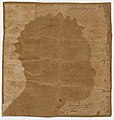
Paper-cut silhouette on paperboard of enslaved adult female Flora.
-

Nib of Sale of the enslaved woman Flora.
War machine usage [edit]

Silhouette of an shipping
Silhouettes of ships, planes, tanks, and other military vehicles are used by soldiers and sailors for learning to place different arts and crafts.
Firearm targets [edit]
-

Human silhouette targets are utilise for military machine, police and noncombatant firearms training.
Silhouette images [edit]
-

A traditional silhouette image of Jane Austen, 18th century
-

Beethoven as a boy, finely cut with details of hair and wear, 18th century
-

Silhouette epitome representing human being development
-

Traffic signs oft use silhouettes. This sign warns that the road crosses a railway line.
-

The flag of Cyprus shows a map of the land in silhouette course. Countries are often identified by silhouette maps.
-

Recent photographic images [edit]
-

Rumination
-

Below Bethesda Terrace
-

Relaxing at a Japanese temple
-

Barack and Michelle Obama watching fireworks
-

Walpurgis dark
-

Lined up for sunset
-

The Silent
-

Sunset at al Masjid al-Nabawi
-

Still h2o at dusk
-
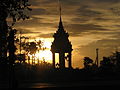
Cambodia at sunset
-

-

Silhouette of the Palace of Westminster
Meet likewise [edit]
- Osborne bull
- Silhouette artists
- Clipping path
References [edit]
- ^ Wells, John (3 April 2008). Longman Pronunciation Dictionary (third ed.). Pearson Longman. ISBN978-one-4058-8118-0.
- ^ a b McClard, Peggy. "History of Silhouette". www.PeggyMcClard.com. Archived from the original on December five, 2007. Retrieved September 12, 2011.
- ^ McLynn pp. 64–65
- ^ Teall, Gardner (Aug 1916). "Silhouettes Old and New". Business firm & Garden. xxx: 20.
- ^ At that place is no mention of de Silhouette making silhouettes in his primeval record in 1834 edition Biographie universelle ou dictionnaire historique contenant la nécrologie des hommes célèbres Volume v. Furne, 1834. P. 2850
- ^ a b c d Custom Silhouette Pictures by Karl Johnson Archived 2009-01-16 at the Wayback Machine, accessed November two, 2008.
- ^ The family name Silhouette is a French form of a Basque surname, Ziloeta; Arnaud de Silhouette, Étienne's father, was from Biarritz in the French Basque State; this surname, whose Standard Basque or Batua form is Zuloeta, contains the suffix -eta "abundance of" and zilo, Batua zulo, "hole".
- ^ R. M. Cook (1976). Review of John Boardman 'Athenian Black Effigy Vases: A Handbook.' The Classical Review (New Series), 26, pp 253-253. doi:10.1017/S0009840X00248610.
- ^ Trendall, A. D. (Arthur Dale Trendall) & National Gallery of Victoria (1966). Greek vases in the Felton Collection. Oxford Academy Press, Melbourne ; New York
- ^ Scientific discipline Daily, accessed November two, 2008.
- ^ Good design lies in the foundation, accessed August 18, 2009.
- ^ a b Roving Artists Archetype portraits
- ^ Silhouette Sarah
- ^ Lavater, accessed November 2, 2008.
- ^ Baronial Edward, accessed Nov 2, 2008.
- ^ John Miers, accessed Nov two, 2008, V&A biography Archived 2012-10-06 at the Wayback Automobile
- ^ brereton.org.united kingdom, Printed advertisement on dorsum of a miniature
- ^ museum "Silhouettes" Archived 2016-04-22 at the Wayback Motorcar
- ^ Freund, Gisèle (1974), Photographie et société, Éditions du Seuil, p. eight-18, retrieved 18 Apr 2016
- ^ Cromer 'Le secret du physoniotrace Bulletin de la société archéologique, historique et artistique, ´Le Vieux Papier,' 26th year, October 1925
- ^ "Silhouette Sarah | Silhouette Artist, Cutter and Entertainer". www.silhouettecutting.co.great britain . Retrieved 2017-01-05 .
- ^ "Mark Conlin | Silhouette Creative person". www.theshadowcutter.co.united kingdom of great britain and northern ireland . Retrieved 2019-09-twenty .
- ^ Tyneside silhouettist inspired family unit-success accessed Feb 4, 2012]
- ^ Creative person brings talent to The Woodlands shop, Houston Chronicle
- ^ The Silhouette Man, accessed November 2, 2008.
- ^ Silhouette artist, accessed November ii, 2008.
- ^ Traditional European paper cuts are dissimilar in this regard to traditional Oriental paper cuts which are often made of several layers of brightly coloured and patterned paper, and take many formal decorative elements such as bloom petals.
- ^ Hans Christian Andersen'south Paper Cuts in the Royal Library, accessed November 2, 2008.
- ^ Mister Rob Ryan, accessed November two, 2008.
- ^ Robbin, T. (2008). Shadows of reality: the fourth dimension in relativity, cubism, and modern thought. The Mathematical Intelligencer, 30(1), 74-75.
- ^ "Collection Online | Man Ray. Silhouette. 1916 - Guggenheim Museum". guggenheim.org. Retrieved March 21, 2016.
- ^ Knipe, P. (2002). Paper profiles: American portrait silhouettes. Journal of the American Plant for Conservation, 41(3), 203-223.
- ^ Le Cabaret du Chat Noir (1881–1897) Archived 2017-02-fifteen at the Wayback Machine, Musée d'Orsay, Paris, 1992
- ^ google.no, Niğde Alaaddin Mosque where a Chiaroscuro cartoon of a woman'south face with crown and long pilus appears at a specific time of the year.
- ^ fotogaleri.haberler.com, Divriği Great Mosque and Infirmary with the silhouette of a praying human that appears over the archway door of the mosque office and changes pose every bit the sun moves.
- ^ Adams, Ansel & Baker, Robert (1995). The camera (1st pbk. ed). Little, Brown, Boston
- ^ Adams, Ansel & Baker, Robert (1981). The negative (1st ed). New York Graphic Society, Boston
- ^ Adams, Ansel & Baker, Robert (2003). The impress. Trivial, Brown and Visitor, Boston
- ^ Evening, Martin (2015). Adobe Photoshop CC for photographers : a professional prototype editor's guide to the creative use of Photoshop for the Macintosh and PC (2nd edition). Burlington, MA, United states of america Focal Printing
- ^ There are over 1,800,000 mentions of the word "silhouette" in conjunction with "fitness" online. There are many "Silhouette Fitness" studios and gymnasiums, e.g. in Halifax, in Bendigo Archived 2011-10-05 at the Wayback Automobile, in Switzerland Archived 2008-10-26 at the Wayback Machine etc
- ^ Forensic entomology Archived 2008-05-10 at the Wayback Machine, accessed November 3, 2008.
- ^ "Soltani, A. A., Huang, H., Wu, J., Kulkarni, T. D., & Tenenbaum, J. B. Synthesizing 3D Shapes via Modeling Multi-View Depth Maps and Silhouettes With Deep Generative Networks. In Proceedings of the IEEE Briefing on Reckoner Vision and Pattern Recognition (pp. 1511-1519)". GitHub. five January 2022.
- ^ Purtill, Corinne. "An enslaved adult female's shadow is the most compelling paradigm in the National Portrait Gallery". Quartz . Retrieved 2021-xi-24 .
- ^ Magazine, Smithsonian; Catlin, Roger. "Rarely Seen 19th-Century Silhouette of a Same-Sexual activity Couple Living Together Goes On View". Smithsonian Mag . Retrieved 2021-eleven-24 .
- ^ "Africans in America/Part two/Flora". www.pbs.org . Retrieved 2021-eleven-24 .
- ^ "'Black Out: Silhouettes Then and Now': Rare art form on display in Mississippi more but shadows of the past". Mississippi Today. 2019-06-14. Retrieved 2021-11-24 .
Bibliography [edit]
- Coke, Desmond (1913). The Art of Silhouette. London: Martin Secker.
- Jackson, Emily (1911). The History of Silhouettes. London: The Connoisseur.
- Knipe, Penley (2002). "Paper Profiles: American Portrait Silhouettes". Periodical of the American Institute for Conservation. 44 (3): 203–223. doi:ten.1179/019713602806082575. S2CID 192205617.
- McKechnie, Sue (1978). British Silhouette Artists and their Work, 1760–1860. London: Sotheby Parke Bernet. ISBN0856670367.
- McLynn, Frank (2005) [2004]. 1759:The Twelvemonth Britain Became Master of the Globe. London: Pimlico. ISBN9780712694186.
- Orr, Inge C. (1974). "Puppet Theater in Asia". Asian Folklore Studies. 33 (1): 69–84. doi:10.2307/1177504. JSTOR 1177504.
- Roe, F. Gordon (1970). Women in Profile: A Written report in Silhouette. London: John Baker. ISBN978-0-212-98364-3.
- Rutherford, Emma (2009). Silhouette: The Art of the Shadow. New York: Rizzoli. ISBN978-0-8478-3077-0.
- Stoichitǎ, Victor (1997). A Short History of the Shadow . Essays in Art & Civilisation. London: Reaktion. ISBN978-1-86189-000-9.
- Sedda, Julia (2014). "Silhouettes: the fashionable paper portrait miniature around 1800". In Pappe, Bernd; Schmieglitz-Otten, Juliane; Walczak, Gerrit (eds.). European Portrait Miniatures: artists, functions and collections. Petersberg: Michael Imhof Verlag. pp. 179–185. ISBN978-3-86568-969-6.
- Sedda, Julia (2009). "Reading circles, crafts, and flower arranging: everyday items in the silhouettes of Luise Duttenhofer (1776–1829)". In Goggin, Maureen Daly; Tobin, Beth Fowkes (eds.). Women and Things, 1750–1950: gendered material strategies. Farnham: Ashgate. ISBN978-0-7546-6550-2.
- Vigarello, Georges (2016) [2012]. The Silhouette: from the 18th century to the nowadays twenty-four hours. Translated by Dörr, Augusta. London: Bloomsbury Visual Arts. ISBN9781474244657.
Picture show [edit]
- Reiniger, Lotte: Homage to the Inventor of the Silhouette Picture show. Dir. Katja Raganelli. DVD. Milestone Motion-picture show, 1999.
External links [edit]
 Media related to Silhouettes at Wikimedia Eatables
- GAP Social club of American Papercutters
- "Silhouettes". Paintings & Drawings. Victoria and Albert Museum. Archived from the original on July 12, 2007. Retrieved August 21, 2007.
- Profile Likenesses of the Executive and Legislature of Georgia (Silhouette Book), by William H. Brown, 1855 [ permanent dead link ] from the collection of the Georgia Athenaeum.
- Kara Walker's A Horrible Beautiful Beast
- Kara Walker's 2007 Whitney Exhibit
- Andersen, Jens (2002). "Scissor Writing". Det Kongelige Bibliotek. Retrieved 22 Nov 2016.
- Ingersoll, Julia (2003). "Wayang Kulit: the Aboriginal Shadow Plays of Bali". Gamelan Tunas Mekar. Retrieved 22 Nov 2016.
Source: https://en.wikipedia.org/wiki/Silhouette
0 Response to "Silhouette Family Is What Happens When Two Fall in Love"
Post a Comment